
How to Build an Industrial Pipe and Joint Trolley
Get Free Quote

A well-designed pipe and joint trolley can make material movement easier, faster, and more organized in manufacturing and warehouse environments. Unlike conventional welded trolleys, a pipe and joint trolley can be assembled, modified, and reused according to changing production requirements.
Pipe and joint systems are commonly used for material handling, line-side supply, kitting, assembly operations, FIFO storage, picking, and internal transportation. By combining coated pipes with compatible joints, wheels, shelves, and accessories, manufacturers can build lightweight and practical trolleys for different industrial applications.
In this guide, we explain how to build an industrial pipe and joint trolley, what components are required, how to choose the right design, and where these trolleys can be used.
What Is a Pipe and Joint Trolley?
A pipe and joint trolley is a modular material-handling trolley constructed using coated pipes and connecting joints instead of conventional welded steel frames.
The pipes form the structural framework, while metal or plastic joints connect the pipes at different angles. Depending on the application, the trolley can also include shelves, roller tracks, castors, handles, trays, and other accessories.
The modular design makes it possible to modify the trolley when production layouts or material-handling requirements change.
Common applications include:
- Moving components between workstations
- Line-side material supply
- Assembly line material handling
- Kitting and picking
- FIFO material movement
- Work-in-process transportation
- Warehouse material handling
- Production-line feeding
- Small-part storage and transportation
Why Use a Pipe and Joint Trolley?
Traditional welded trolleys are strong and useful for many applications, but changing their dimensions or configuration can be difficult.
A pipe and joint trolley offers greater flexibility because the structure can be assembled and reconfigured.
1. Modular Construction
The trolley can be designed according to the required length, width, and height. Pipes can be cut to the required dimensions and connected using suitable joints.
2. Easy to Modify
If the production process changes, shelves, handles, roller tracks, or other components can be repositioned or added.
3. Lightweight Structure
ABS-coated pipes and modular joints can provide a practical structure that is easier to handle than many heavy welded constructions.
4. Reusable Components
One of the major advantages of a modular pipe and joint system is that components can potentially be dismantled and reused for another trolley or workstation design.
5. Suitable for Lean Manufacturing
Pipe and joint systems are widely suited to lean material handling because they allow manufacturers to create practical solutions close to the point of use.
Components Required to Build a Pipe and Joint Trolley
The exact components depend on the trolley design and application. A typical industrial pipe and joint trolley may require the following:
1. ABS Coated Pipe
The pipe forms the main frame of the trolley.
ABS-coated pipes are commonly selected for modular industrial structures because the outer coating provides a finished surface suitable for material-handling applications.
Pipe diameter, length, coating, and load requirements should be considered before selecting the pipe.
2. Pipe and Joint Connectors
Metal joints or suitable modular connectors are used to connect horizontal and vertical pipes.
Different joint configurations are available for straight connections, corners, T-junctions, cross connections, and other frame arrangements.
Selecting the correct joint is important because the connection affects the overall stability of the trolley.
3. Castor Wheels
Castors allow the trolley to move between workstations, storage areas, assembly lines, and other locations.
Depending on the application, you may choose:
- Swivel castors
- Fixed castors
- Castors with brakes
- Different wheel materials and sizes
The wheel capacity should be selected according to the total trolley load.
4. Shelves or Platforms
Shelves provide space for storing and transporting components.
Depending on the application, shelves may be made using materials such as:
- Laminated boards
- Plywood
- HDPE
- Metal sheets
- Other suitable industrial materials
5. Roller Tracks
For applications involving cartons, bins, trays, or containers, roller tracks can be integrated into the trolley.
A roller-based design can make it easier to move materials along the trolley and can be particularly useful for FIFO material handling systems.
6. Handles
A properly positioned handle makes the trolley easier to push and control.
The handle height should be comfortable for the operators who will use the trolley regularly.
How to Build a Pipe and Joint Trolley Step by Step

Step 1: Define the Trolley Application
Before assembling the trolley, determine what the trolley needs to do.
Ask:
- What material will it carry?
- What is the approximate load?
- How many shelves are required?
- Will boxes, bins, trays, or components be transported?
- Does the trolley need FIFO movement?
- How frequently will it be moved?
- What is the available aisle or workstation space?
Defining the application first helps avoid unnecessary modifications later.
Step 2: Decide the Trolley Dimensions
Determine the required:
- Length
- Width
- Height
- Number of shelves
- Shelf spacing
- Handle height
- Wheel size
For example, a trolley designed to supply small components to an assembly workstation may require a compact footprint, while a warehouse trolley may need a larger loading area.
The dimensions should also consider doorways, aisles, machine access, and operator movement.
Step 3: Select the Pipe
Choose the appropriate coated pipe according to the trolley size and expected load.
For larger or heavier structures, the frame may require additional supports or a different structural configuration.
Do not select pipe only based on dimensions. Consider the complete frame design and the expected load distribution.
Step 4: Cut the Pipes to Required Lengths
Measure the required dimensions and cut the pipes accordingly.
Prepare separate pipe sections for:
- Vertical supports
- Horizontal supports
- Shelf frames
- Handles
- Additional bracing
Accurate measurements help ensure that the finished trolley remains square and stable.
Step 5: Assemble the Main Frame
Connect the vertical and horizontal pipes using the appropriate joints.
Start by assembling the base frame. Then add the vertical supports and upper frame.
Check the structure regularly during assembly to ensure that the frame is properly aligned.
Step 6: Install the Shelves
After completing the main frame, install the shelf supports and shelf surfaces.
Maintain adequate spacing between shelves based on the size of the materials being transported.
If the trolley is intended for small bins or components, multiple levels can improve the available storage area without significantly increasing the footprint.
Step 7: Install Roller Tracks if Required
For FIFO or gravity-flow applications, roller tracks can be installed on the required shelf levels.
The roller arrangement should allow containers or bins to move smoothly while preventing unwanted movement or falling.
A slight inclination may be incorporated where appropriate for gravity-flow applications, depending on the material and trolley design.
Step 8: Install Castor Wheels
Attach the selected castors to the bottom of the trolley.
For a mobile industrial trolley, wheel selection should consider:
- Total load
- Floor condition
- Required manoeuvrability
- Travel distance
- Wheel diameter
- Braking requirement
For example, a trolley used around an assembly area may benefit from swivel castors, while specific applications may require a combination of fixed and swivel wheels.
Step 9: Add the Handle
Install a suitable handle at a comfortable operating height.
The handle should provide a secure gripping area and allow the operator to push the trolley without interfering with the transported material.
Step 10: Check the Finished Trolley
Before using the trolley, inspect:
- Joint connections
- Pipe alignment
- Shelf stability
- Wheel mounting
- Brakes
- Handle strength
- Overall trolley balance
Test the trolley with a controlled load before putting it into regular production use.
Pipe and Joint Trolley Design Considerations


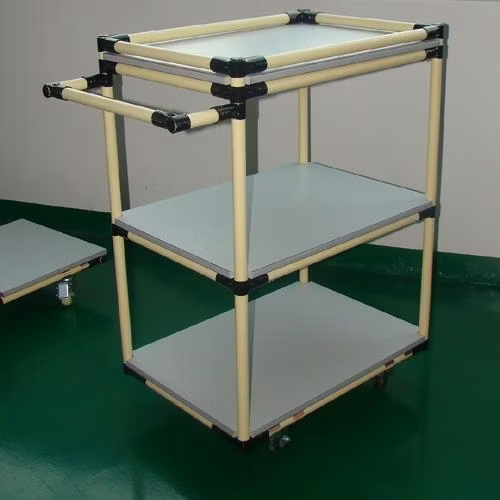

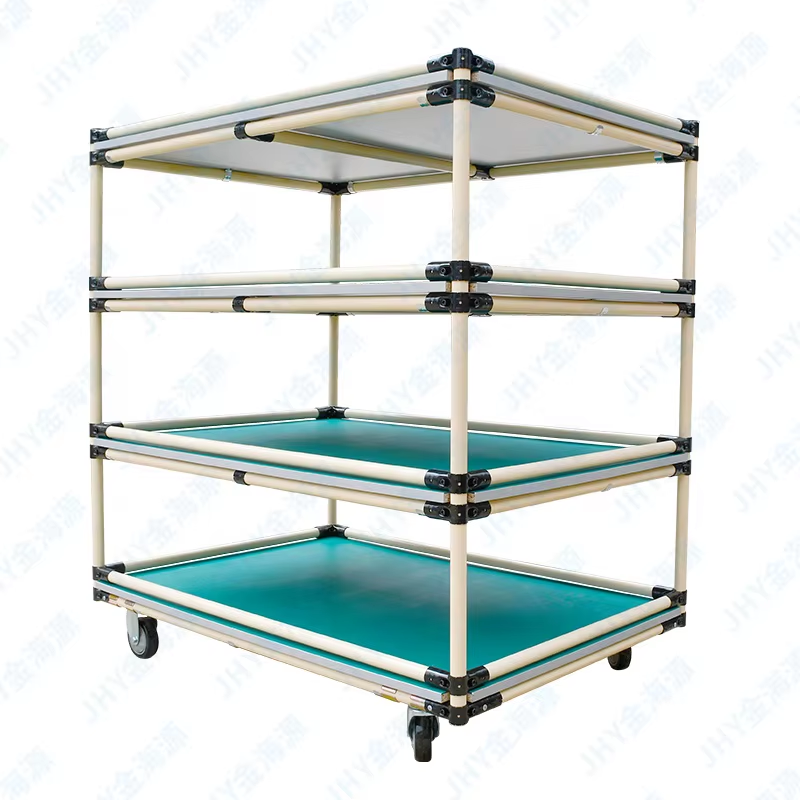
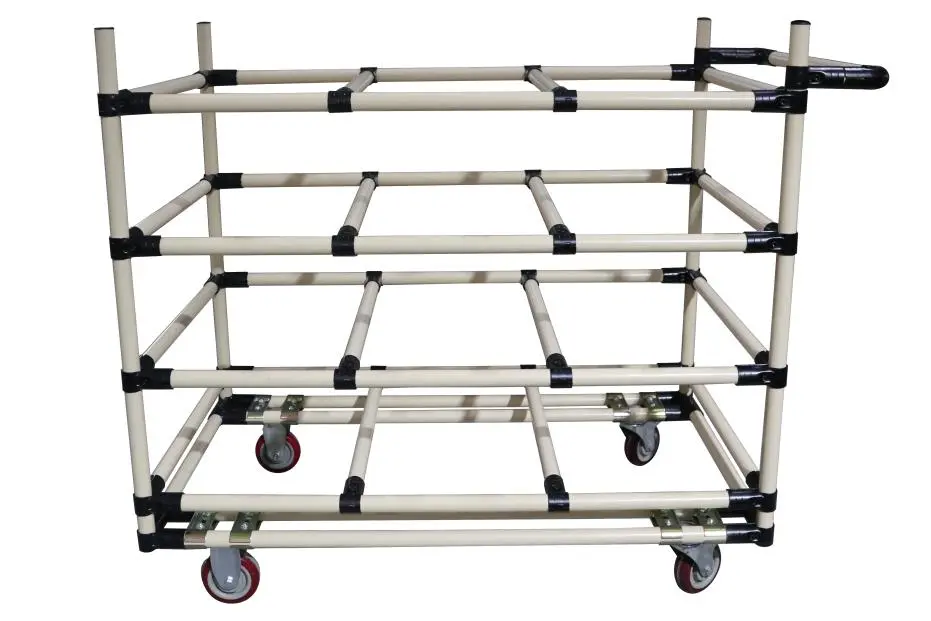
A good trolley is not simply a frame mounted on wheels. The design should match the actual material-handling process.
Load Capacity
Determine the maximum expected load before selecting the pipe, joints, shelves, and castors.
The load should be distributed properly across the trolley rather than concentrated in one area.
Centre of Gravity
Heavy materials should generally be positioned lower on the trolley where practical.
A lower centre of gravity can improve stability during movement.
Operator Ergonomics
Consider the operator’s working height and pushing position.
A trolley that is too high, too low, or difficult to manoeuvre can create unnecessary handling effort.
Floor Conditions
The trolley wheel selection should match the floor surface.
Concrete floors, production floors, warehouse floors, and uneven surfaces may require different wheel specifications.
Space Utilisation
A modular trolley can be designed around the available production space.
Using vertical space effectively can increase material capacity without requiring a much larger floor footprint.
Pipe and Joint Trolley Applications
Industrial pipe and joint trolleys can be used across different manufacturing and material-handling operations.
Assembly Line Material Handling
Components can be transported directly to assembly stations, reducing unnecessary movement by operators.
Line-Side Supply
Trolleys can be positioned close to production lines to keep frequently used components within easy reach.
FIFO Material Handling
When fitted with suitable roller tracks, pipe and joint structures can be used for FIFO material-flow applications.
Kitting Trolley
A trolley can be configured with multiple shelves or bins for collecting components required for a particular assembly or production order.
Warehouse Trolley
Modular trolleys can be used for moving small and medium-sized components around warehouses and production areas.
Work-in-Process Transportation
Manufacturing operations can use trolleys to move partially completed products between different workstations.
Pipe and Joint Trolley vs. Conventional Welded Trolley
Both systems have their own applications.
| Feature | Pipe and Joint Trolley | Welded Trolley |
|---|---|---|
| Construction | Modular assembly | Permanent welded frame |
| Modification | Easy to modify | More difficult |
| Reconfiguration | Possible | Usually requires fabrication |
| Component reuse | Possible | Limited |
| Design flexibility | High | Moderate |
| On-site assembly | Possible | Usually fabrication required |
| Lean manufacturing use | Excellent for modular applications | Suitable for fixed applications |
The best choice depends on the load, environment, design requirements, budget, and expected future changes.
How Pipe and Joint Systems Support Lean Manufacturing
Lean manufacturing focuses on reducing unnecessary movement, waiting, excess inventory, and inefficient processes.
A modular pipe and joint system can support these objectives by allowing material-handling equipment to be positioned close to where materials are required.
For example, a production area can use a combination of:
- Pipe and joint trolleys
- FIFO racks
- Roller tracks
- Workstations
- Material racks
- Kitting carts
- Line-side storage systems
These solutions can help create a more organised material flow between storage and production.
The biggest advantage is flexibility. When production requirements change, modular structures can often be modified instead of completely replaced.
Tips for Building a Better Industrial Trolley
Follow these practical guidelines when designing your trolley:
1. Start with the material, not the trolley.
Understand the size, weight, quantity, and handling method of the materials first.
2. Keep the design simple.
Avoid unnecessary pipes, joints, shelves, or accessories.
3. Use the correct joints.
The joint configuration should match the structural requirements.
4. Select wheels based on the actual load.
Do not select casters only by size.
5. Consider ergonomics.
The trolley should be comfortable and safe for regular operator use.
6. Plan for future changes.
A modular structure can be designed so shelves, handles, or accessories can be changed later.
7. Keep material flow in mind.
The trolley should support the movement of materials rather than create additional handling steps.
Common Mistakes to Avoid
Overloading the Trolley
Exceeding the recommended capacity of the frame, joints, shelves, or castors can affect stability and performance.
Incorrect Wheel Selection
Small or unsuitable wheels can make a loaded trolley difficult to move.
Poor Joint Alignment
Improperly aligned joints can result in an uneven or unstable frame.
Ignoring Aisle Width
Always check the trolley dimensions against the actual movement area.
Making the Trolley Too Large
A larger trolley is not always better. It should match the quantity of material required at the point of use.
Not Planning Material Flow
The trolley should be designed around how materials are picked, supplied, used, and returned.
Why Choose a Modular Pipe and Joint System?
A modular pipe and joint system provides manufacturers with a practical way to develop customised material-handling equipment.
Instead of purchasing a completely new welded structure whenever requirements change, manufacturers can modify the existing design by changing pipe lengths, shelf positions, joints, roller tracks, or accessories.
This makes pipe and joint systems particularly useful for lean manufacturing, flexible production layouts, line-side material supply, FIFO systems, and industrial material handling.
Get the Right Pipe and Joint Components for Your Trolley
Building a reliable industrial trolley starts with selecting the right components for the application.
At LeanMart by Leantech Engineering, you can source components for modular material-handling solutions, including ABS coated pipes, pipe and joint connectors, roller tracks, aluminium profiles, and related industrial components.
Whether you need a simple pipe and joint trolley, a FIFO material-flow system, a line-side material trolley, or a customised lean material-handling solution, the design can be developed according to your production requirements.
Need help designing your pipe and joint trolley? Contact LeanMart with your required trolley size, load capacity, shelf configuration, and application.
Frequently Asked Questions
1. What is a pipe and joint trolley?
A pipe and joint trolley is a modular industrial trolley made using coated pipes, connecting joints, wheels, shelves, and other accessories. It is used for material handling, line-side supply, kitting, storage, and transportation.
2. What pipe is used for a pipe and joint trolley?
ABS-coated pipes are commonly used for modular pipe and joint structures. The appropriate pipe should be selected based on the trolley design, load, dimensions, and application.
3. Can a pipe and joint trolley be customised?
Yes. A modular trolley can be designed with different lengths, widths, heights, shelf levels, roller tracks, handles, and castor configurations according to the application.
4. Can roller tracks be used on a pipe and joint trolley?
Yes. Roller tracks can be integrated into suitable trolley designs for moving bins, trays, cartons, and components. They are particularly useful for FIFO material-flow applications.
5. What are pipe and joint trolleys used for?
They are used for line-side material supply, component transportation, kitting, assembly operations, FIFO material handling, warehouse movement, and work-in-process transportation.
6. Are pipe and joint trolleys better than welded trolleys?
It depends on the application. Pipe and joint trolleys provide greater modularity and easier modification, while welded trolleys may be preferred for certain fixed or heavy-duty applications.
7. How do I choose the right castors for a pipe and joint trolley?
Consider the total loaded weight, floor condition, movement frequency, required manoeuvrability, wheel diameter, and whether brakes are required.
8. Can a pipe and joint trolley be reused?
One of the key benefits of a modular pipe and joint system is that components can often be dismantled and reconfigured for another application, subject to their condition and suitability.
Conclusion
A properly designed pipe and joint trolley can improve material movement, organisation, and flexibility in manufacturing and warehouse environments.
By combining ABS-coated pipes, modular joints, shelves, roller tracks, and suitable castors, manufacturers can create trolleys for different applications without relying entirely on permanent welded structures.
The most effective trolley is one designed around the actual material flow, load requirements, operator needs, and available production space.
For manufacturers looking to improve lean material handling and line-side material flow, a modular pipe-and-joint trolley can be a practical starting point.